
Invoice Factoring Blog
Practical insights on invoice factoring, including agreement structures, costs, payment terms, and industry conditions that can affect your company while invoices are unpaid.


The case for keeping fuel and factoring separate is not new. But the freight downturn that started in 2022 made the risk easier to see.
Over the last few years, carriers got squeezed from both sides. Rates fell. Insurance went up. Equipment stayed high. Maintenance did not back off. Compliance still had to be paid for.
A lot of carriers spent that stretch watching cash more closely than ever.
That is usually when a bundled setup gets tested.
If one part stops fitting, the real question is whether that piece can be fixed without disturbing the rest.
During a weak market, having control to adjust one cost without pulling fuel, funding, and next week’s bills into the same problem is crucial.
Some factoring companies put several services under one agreement. This package may include factoring, fuel cards, dispatch help, load boards, or insurance products.
At signup, this can look easier. One provider. One agreement. One place to manage it.
But how it looks on the front end may not be the whole story.
The real question is what happens later if one piece stops working for you.
You should be able to change one service without disturbing the rest. This is where bundling can start to work against a carrier.
A factoring agreement can be one of the most complicated contracts you sign.
If you plan to stop factoring at some point, your fuel program should not depend on that agreement. Once the two are tied together, leaving the factor can get a lot harder.
Trucking moves in cycles. What looks fine in a stronger market can feel tight in a weaker one.
That is because bundled agreements can take away the ability to change one service at a time.
A carrier may find that the fuel card is no longer competitive, but the contract still ties them to it.
Or the factoring terms may change, and leaving that program may also mean losing fuel access.
Once factoring and fuel are bundled together, changing either service is no longer simple.
A carrier may want to switch fuel cards, but doing so could require buying out the factoring agreement as well.
And truth be told, changing factoring companies is usually much harder than changing fuel providers.
So a carrier who only wants a different fuel program may end up stuck in a factoring contract they no longer want.
That is the catch. What looked organized at the beginning can turn into extra cost and extra work later.
And when margins are thin, one bundled agreement can turn a fuel decision into a funding problem fast.
Fuel and factoring should not need the same contract. Keeping them separate gives you more control, so you can judge each one on its own.
A factoring partner should fund your invoices when expected, make credit decisions you trust, keep costs clear, and release your reserve, if any, in a timely manner after your customer pays.
The fuel card provider should give you a card that works where your drivers stop, with discounts that still make sense each week.
Bundled minimums can make it hard to see what each service is really costing you. And when that cost gets harder to track, it gets harder to judge how profitable your load is.
One case where bundling can make sense is when you can’t qualify for fuel credit on your own. In that situation, your options may be limited to a cash deposit or a fuel account backed by the factor.
But if you already have established credit, you may be able to negotiate strong fuel discounts on your own without tying your fuel program to your factoring agreement.
When services stay separate, you can compare prices, replace one provider without replacing both, and avoid giving one agreement too much control.
The last few years drove home a hard lesson. In a weak freight market, controlling cost matters just as much as keeping trucks moving.
A lot of carriers used that period to look harder at every major expense:
The carriers who could review those relationships one at a time could fix one weak point without reopening every other agreement.
They could change a fuel program or review factoring terms without having to pull apart several services at once.
That kind of control matters when rates drop and the bills do not.
Unbundling is not about rejecting ease. It is about not giving up options you may need later.
The trucking industry has been through enough cycles to know how fast conditions can change. A lot of carriers are still trying to keep fuel covered, pay drivers, and stay ahead of the rest of the bills.
Keeping fuel and factoring separate will not fix every problem. But it does give you more room to respond when conditions change.
And for many carriers, that is enough reason to keep the two apart.
If you want a factoring company that can walk you through an agreement clearly and help you compare it without pressure, OCC can do that on one quick call.
“Always a phone call away, always eager to help, and always getting the issues solved.”
—Vitaliy, Freight Carrier,
Oregon
We’ll look at one agreement with you, point out what is tied together, and tell you what to ask about open invoices, reserve money, fees, and switching.
Since 1979
Talk to a rep. Agreement review. No phone menu.
1-800-231-3878
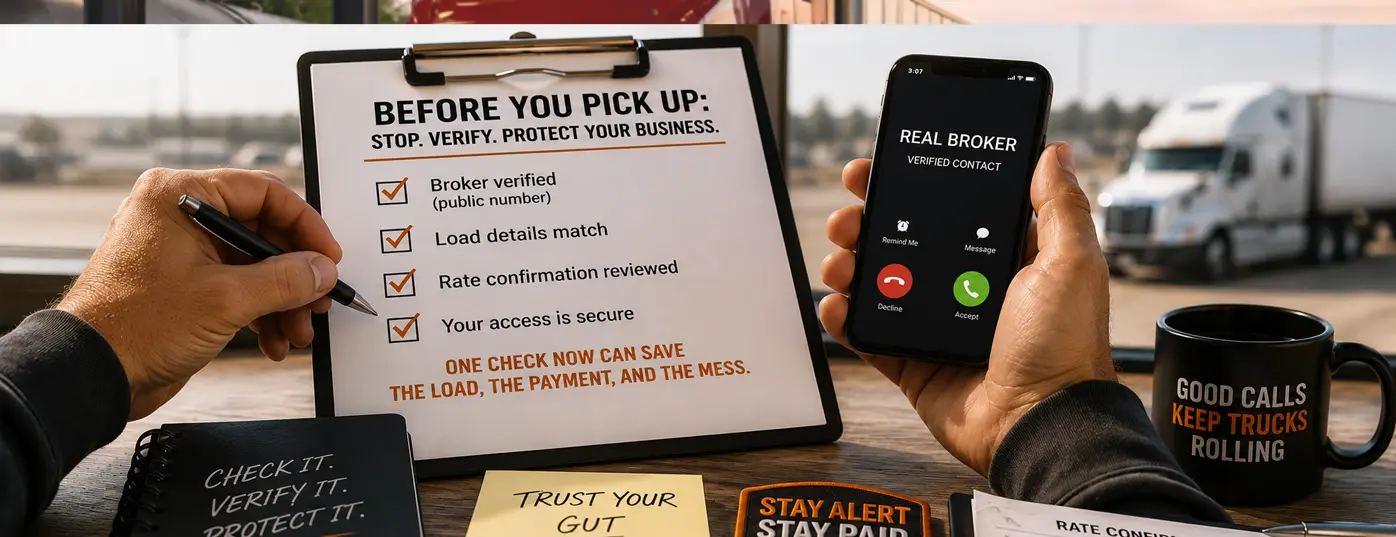
If you’ve been in trucking for any length of time, you’ve seen fraud change.
It used to be something you heard about once in a while: a bad broker, a stolen load, or a fake invoice.
Today, it’s different. We’re at a point where fraud shows up in our office almost every day.
That’s not an exaggeration. It’s what the freight market looks like right now.
And if you’re a carrier, the most important thing to know is this: fraud is not just happening around the load anymore.
Fraud can start before pickup.
A rate confirmation—the load paperwork showing the broker, pickup, delivery, and pay—looks normal.
The broker name looks familiar.
The pickup looks real.
The email sounds like any other email you get during the week.
Then one detail is off.
The email domain does not match.
The phone number is wrong.
The load was never posted by the broker.
Or the carrier name on the paperwork is yours, but you never booked the load.
When one small detail gets missed, a carrier can haul a fraudulent load without knowing it.
Let’s walk through what we’re seeing day to day, and what it means for your business.
Historically, fraud and theft were easier to separate.
Theft was physical: a stolen trailer, a hijacked load, or freight taken from a yard, warehouse, or truck stop.
Fraud was usually paperwork: a fake invoice, a double-brokered load, or a carrier or broker name used the wrong way.
That line is not so clear anymore. Today’s schemes often combine both.
Someone may use a broker’s name, email, or load board account. They may send a rate confirmation that looks close enough to pass at a glance. They may copy a real company’s information and change one letter in an email domain.
By the time a truck is dispatched, the fraud may already be in the paperwork.
That is why so many carriers say the same thing after something goes wrong: “Everything looked right.”
The load can move before anyone catches the mismatch.
These scams are built to look normal. Missing one detail does not mean you were careless. It means the fraud was designed to get past a busy person on a busy day.
Trust your gut. If something feels off, slow down and check the parts that matter before the freight is on the truck.
Even if you’ve already accepted the load, stop and verify. You still have a safe exit before pickup.
Contact the broker through a publicly posted phone number, not the number in the email or on suspicious paperwork.
Verify:
If the broker says the load was not assigned to your company, the rate does not match, or the agent is not legitimate, cancel the load before pickup. Do not load the freight.
If one detail does not match,
stop and verify.
That one pause may save the load, the invoice, and the mess
that follows.
Here are five warning signs of fraud we’re seeing right now with carriers we work with. Any one of them is a reason to stop and verify.
One warning sign carriers may see on their end is a broker suddenly posting far more loads than usual.
For example, a broker who does not post very often may suddenly show 20 loads within an hour.
That does not automatically mean the loads are fraudulent. But it is enough of a change to slow down and verify before pickup.
We check broker credit to see whether that broker has a pay history we’re comfortable with before we buy invoices connected to that broker.
If several carriers check the same broker in a short period of time, that can mean the broker has a lot of real freight in the market.
But it may also mean the broker’s load board account was compromised and fake loads are being posted under that broker’s name.
One carrier may see one load. We may see the same broker checked again and again.
When we see that pattern, we can contact the broker directly and alert the carriers who pulled credit to confirm the load before pickup.
If a load seems unusually active, urgent, or widely available, do not let the rush make the decision for you. Stop and verify.
We are also seeing more brokers send fraud alerts to factoring companies.
Those alerts may say their system was compromised, fake loads were posted, or someone is impersonating their company.
That is a good sign in one way. It means brokers are warning people faster.
But it also tells you how often this is happening.
Fraud is not only hitting small companies. It is hitting known brokers, established carriers, and companies that already have security steps in place.
The weak handoff might be an email, a password, a rate confirmation, a phone number, a portal login, a carrier packet, or one rushed click.
That is why the before-pickup check matters.
This is one of the most important shifts we’ve seen.
More carriers are trusting their instincts. They’ll call and say:
“Can you look at this rate confirmation?”
“This email seems off.”
“Something does not feel right about this load.”
We’ll look at the rate confirmation, broker credit, email domain, contact details, load information, formatting, and broker portal assignment if there is one.
We also look for warning signs that one carrier may not see alone.
The carrier should still verify the broker through a number they look up themselves.
But the second set of eyes can help them know what to verify before the truck leaves.
Carrier identity theft starts when someone uses your MC number, name, or paperwork without you.
They may book loads under your name; they may redirect payments; they may use your company information to make fake paperwork look real.
Sometimes the carrier does not know anything happened until a broker calls about a load they never hauled.
And by then, the damage may already be spreading.
A stolen carrier identity can lead to fake loads booked under your name, payment problems, platform blocks, or reputation damage with brokers and shippers.
This is why you should check your FMCSA record—the public record tied to your MC number. Make sure the phone number, email, and company details are correct. If someone changes that information, they may be trying to put themselves between you and your freight.
Also be careful with your carrier packet. Do not send it to someone just because they call and ask. If the request is unsolicited, verify who they are first.
Your MC number is how brokers and shippers recognize your company. Protect it.
A stolen identity is not the same as a stolen load.
A fake rate confirmation is not the same as a hacked email account.
But the first move is the same: act fast and tell the right people.
Start with the records and accounts that control your business.
Fraud is not new. But the way freight gets booked and moved has changed, and fraudsters have changed with it.
Digital onboarding made booking faster.
That helped the industry move more loads with fewer phone calls.
But it also gave fraudsters more room to move fast before anyone checked the details.
More work now happens by email, text, portals, and online forms.
That makes it easier for someone to impersonate a broker, carrier, dispatcher, or shipper.
When rates are tight, carriers may feel more pressure to grab a load fast.
Fraudsters know that. They use urgency because it works.
They may offer an unusually high rate, or use phrases like:
“Book this now.”
“Pickup is today.”
“Send the packet fast.”
“Click this setup link.”
That pressure is the trick.
One of the biggest misconceptions we still hear is: “This will not happen to us.”
But fraud does not only target one kind of company.
Fraudsters look for a vulnerable spot in the transaction. They use copied emails, fake domains, exposed MC numbers, stolen passwords, or other tricks to make the load look real.
In Montgomery v. Caribe Transport II, LLC, the U.S. Supreme Court allowed a lawsuit against a freight broker to move forward after a serious crash. The claim says the broker hired a carrier despite safety red flags.
The Court did not decide who was at fault. It only said the case can continue.
This case is about broker hiring and carrier safety, not freight fraud. But it points to a bigger shift in trucking: more attention on who is being hired, assigned, and verified before freight moves.
For carriers, that may mean more checks around carrier identity, FMCSA status, insurance, safety history, and whether the person booking the load is legitimate.
That can feel like extra work. But it comes back to the same rule:
Verify before pickup.
Related Reading:
Associated Press Coverage of the Ruling
Cornell Law Summary of Montgomery v. Caribe Transport II,
LLC
At Orange Commercial Credit, we know that paperwork can show warning signs before payment ever becomes the issue.
We look at broker credit, rate confirmations, invoice packets, carrier questions, and payment patterns every day.
That daily view can help us see what one carrier alone may not see.
No one can promise every fraud attempt will be caught. But a second set of eyes on the paperwork can help before the truck leaves.
Fraud works best when everybody is rushing.
The carriers who protect themselves are not the ones who stop taking freight. They are the ones who pause long enough to verify before pickup.
If a rate confirmation, email, broker contact, or MC number looks off, or if something just doesn’t feel right, call Orange Commercial Credit before the truck leaves.
We can look at the details with you and tell you what we see.
“My account executive reviewed my paperwork and explained step by step what I needed to do, including who to
contact, what numbers to reference, and what I needed to ask. I could see that they really care and
understand how big a $4,500 loss is to any trucking company.”
— Alyssa, Owner, Long-Haul
Trucking Company, Detroit, MI
Since 1979
Talk to a rep. Load check before pickup. No phone menu.
1-800-231-3878

Once a business decides to use factoring to improve cash flow, it typically faces a choice between two common types of agreements: recourse and non-recourse factoring.
At its core, the distinction between recourse and non-recourse factoring revolves around who bears the risk of non-payment by the factoring client’s customer, commonly referred to by factors as the “debtor.”
If your customer doesn’t pay, who has responsibility for the risk?
Your business? Or your factoring company?
It depends on the kind of factoring arrangement you have, the fine print of your specific agreement, and the reason the invoice wasn’t paid.
By understanding the difference between recourse and non-recourse factoring, and the exclusions written into a specific agreement, you can choose a factoring program that aligns with your risk and cost needs.
Recourse factoring involves an agreement where the client retains responsibility for the invoices sold. If your customer fails to pay the invoice within a specified period, you are required to buy back the unpaid invoice from the factoring company.
While this option provides immediate cash flow, it comes with the risk that the business will need to cover the unpaid invoice if the customer does not pay.
In this arrangement, if your approved customer fails to pay an invoice due to certain credit reasons outlined in your specific agreement, the factoring company absorbs the loss. This can provide a sense of security, especially for businesses concerned about managing cash flow while also avoiding bad debts.
However, non-recourse protection usually applies only to specific causes of nonpayment, such as bankruptcy or insolvency, when the customer cannot pay its debts.
Non-recourse does not necessarily mean your business has no responsibility for the invoice. For example, the agreement may still make you responsible when the customer disputes the work, questions the invoice, claims the required paperwork is incomplete, or pays slower than the recourse period.
The specific agreement and its fine print, not just the name of the program you enroll in, will determine what is covered.
Recourse factoring generally offers a lower discount rate, as the factor does not assume the same level of risk. Depending on the situation, the difference in the fee can be 1% or greater. Since the client remains responsible for any unpaid invoices, the factoring company is exposed to fewer potential losses, allowing them to offer better terms.
Non-recourse factoring tends to be more expensive than recourse factoring. This is because the factoring company takes on more risk by assuming responsibility for certain unpaid invoices.
As a result, they charge higher fees or a higher discount rate to offset the increased risk to the factoring company. Additionally, non-recourse accounts may hold a reserve in situations where recourse accounts may not.
Paying a higher fee for non-recourse factoring does not mean every unpaid invoice is covered.
The agreement will specify which specific customers and invoices qualify, which causes of nonpayment are covered, and which exclusions could leave your business responsible.
While non-recourse factoring provides additional credit risk protection for businesses, it’s important to understand that it’s not entirely risk-free. It’s a common misconception that non-recourse means no chargebacks; this is not the case.
Non-recourse agreements often contain exceptions and exclusions that could leave your business liable under certain circumstances. Common examples include:
Under non-recourse agreements, customer approvals and restrictions tend to be tighter, and each customer also needs to be approved for non-recourse coverage before the invoice is funded. The factoring company may exclude certain customers or invoices at its sole discretion to mitigate risk.
This creates implications for truckers, as non-recourse factoring can restrict what loads get approved for factoring. Non-recourse factors may not approve brokers and shippers that recourse factors will.
Non-recourse factors might only approve A+ to A rated debtors and pass on B rated debtors.
More restrictive customer approvals for non-recourse factoring can severely limit the ability of a new carrier to get loads.
That is why it is important to ask which customers qualify and whether the approved credit limits could affect the work your business accepts.
Certain industries are considered a higher risk for non-recourse factoring. Factors may exclude certain types of receivables or industries that have a history of frequent defaults.
If your customer disputes the work, delivery, quantity, quality, or invoice amount, your business may still be responsible for resolving the dispute. Non-recourse protection generally applies to covered credit failures like bankruptcy or insolvency, not disagreements over whether the invoice is valid. Defaults due to disputes over goods or services will not be covered.
Non-recourse agreements do not protect invoices involving fraud, duplicate billing, false information, or misrepresentation by the business selling the invoice. This is a common misconception to take note of.
Non-recourse agreements also often require the client to maintain proper documentation, including invoices, delivery receipts, insurance, and contracts. Failure to comply with these terms could result in exclusions from the non-recourse protection.
Furthermore, the client is required to maintain insurance and relevant licenses to remain compliant with their customer contracts.
If the paperwork does not support the invoice and contractual obligations, the protection may not apply.
No. It's important to understand that non-recourse factoring and credit insurance are two different products that provide protection in different ways.
Non-recourse factoring is a contractual arrangement with your factoring company. You sell your invoices for immediate cash, and the factor assumes the risk of customer non-payment due to specific reasons like insolvency, as part of that sale.
Credit insurance is a separate coverage provided by your insurance company. When you purchase a credit insurance policy, the insurance covers you in the event of a loss, but you retain ownership of your receivables.
There is a misconception that non-recourse factoring protects you against any customer loss. In reality, non-recourse protection may exclude disputes, claims, short-payments, and other non-insolvency-related losses.
Whether you have a recourse or non-recourse contract with your factoring company, purchasing credit insurance can be an additional added layer of protection. However, it’s important to understand that non-recourse factoring and credit insurance are separate products, with different coverage, exclusions, and terms.
If you're using both services together, it's worth getting professional advice on how the two interact and where exclusions in each might leave you exposed.
The right choice depends on several key factors, including your business’s financial situation, risk tolerance, customers, and cash flow needs.
Non-recourse factoring is more attractive for businesses that deal with high-risk customers or operate in industries prone to defaults.
When you choose a non-recourse agreement, your factoring company will run credit checks to determine if you are eligible for a non-recourse agreement.
Next, your factoring company will run thorough credit checks on your customers to assess your customers’ credit to determine whether they qualify for non-recourse.
Some of your customers may not qualify for non-recourse factoring.
Additionally, in non-recourse agreements, credit limits on each approved customer may be lower than in recourse agreements.
Again, this can be particularly crucial in industries like trucking, as non-recourse factoring can restrict what loads get approved for factoring.
Non-recourse factors may not approve brokers and shippers that recourse factors will. For example, non-recourse factors might only approve A+ to A rated debtors and pass on B rated debtors.
As mentioned, more restrictive customer approvals for non-recourse factoring can severely limit the ability of a new carrier to get loads.
On the other hand, recourse factoring works well for businesses with reliable customers whose payment histories are strong. Keep in mind that recourse factoring still includes robust credit checking and due diligence on customers.
If your customer base has a track record of paying on time, recourse factoring may provide you with the flexibility of lower fees without taking on unnecessary risk.
If your business is particularly risk-averse and you want to minimize exposure to unpaid invoices, non-recourse factoring might be the right choice. It can be beneficial if you’re concerned about the potential financial impact of defaults due to covered reasons.
However, if you’re comfortable accepting some risk and want to reduce your factoring costs, recourse factoring might be more suitable.
Non-recourse factoring typically comes at a higher factoring fee due to the additional risk the factor assumes. If minimizing risk is your priority and you have the budget to absorb the higher fees, non-recourse factoring can provide peace of mind.
However, if your focus is on reducing operational costs, recourse factoring may offer a more economic option, especially if you have reliable customers. Keep in mind, a recourse factoring program will still include credit checks and analysis on your customers as well.
Always ask for a written example showing:
Different industries face varying levels of bad debt risk.
For instance, the transportation industry is particularly high-risk for customer defaults due to fraud, making non-recourse factoring an appealing option. However, the industry's low profit margins can make non-recourse factoring prohibitively expensive. In such cases, partnering with a highly experienced recourse factoring company can offer the best of both worlds—providing lower costs while minimizing risk through diligent customer credit checks.
As mentioned, while a customer’s bankruptcy or inability to pay its debts may be covered by non-recourse protection, common exclusions include:
The distinction is whether the invoice remains unpaid because of a covered customer credit failure or because the customer disputes the invoice, the work, or the supporting paperwork. Exact coverage depends on the terms and exclusions in the agreement.
When considering recourse factoring, it’s essential to understand how the factoring company will handle collections. Ask how the factoring company will review customer credit, track unpaid invoices, contact customers, and alert you of disputes or missing paperwork.
A company like Orange Commercial Credit is known for its strong credit checks and collections services, which results in fewer chargebacks and defaults.
It’s important to assess how diligent the factor is with credit assessments and when they will begin contacting customers for payments. Additionally, is the factoring company proactive about notifying you of any discrepancies, so that you can resolve potential issues before the invoice is charged back?
For non-recourse factoring, ask what the factor does when an approved customer has a credit failure.
Finally, consider how factoring fits into your overall cash flow strategy. If your business requires flexible financing with minimal risk, non-recourse factoring may be the most appropriate choice. However, if you are more focused on cost-effective financing and have a reliable customer base, recourse factoring might better align with your objectives.
Choosing between recourse and non-recourse factoring is a critical decision that will depend on your business’s cash flow needs, risk tolerance, and industry specifics.
Non-recourse factoring provides more security by transferring the credit risk of customer defaults to the factoring company, but it comes at a higher cost and with specific exclusions. Recourse factoring is more cost-effective but involves some risk for the client in case their customer defaults due to bankruptcy or insolvency.
Alongside asking "who will cover my non-payment," business owners should also be asking, "how do I avoid working with bad-paying customers in the first place?"
No matter what financing or credit protection structure you use, the best way to avoid a loss is to prevent it. At Orange Commercial Credit, we assist clients in running credit checks, and we're transparent with our carriers about what we're seeing on their debtors.
In our experience, it is extremely rare for a customer to go out of business without warning signs first: we have a history of catching those signs early and communicating with our carriers.
Before choosing, ask a factoring company to walk through a real example:
If this customer does not pay this invoice, what happens next?
The answer should identify the covered event, exclusions, timing, required paperwork, and the point at which your business could become responsible.
If you want help answering these questions in relation to your own customers and invoices, consider calling Orange Commercial Credit, a factoring company with decades of experience in customer credit review and collections.
“I get explanations instead of being sent a document that I have to go through.”
— Mac, Precision Contract
Manufacturing, North Carolina, Client of 6 Years
We’ll start with one customer and one invoice, discuss the differences between recourse and non-recourse factoring, and identify the questions to ask before you decide.
By thoroughly assessing your customer base, understanding the cost implications, and evaluating your risk appetite, you can choose the factoring option that aligns with your business’s financial goals.
Consider working with a factoring company like Orange Commercial Credit, known for its strong track record of credit and collections services, which can help reduce chargebacks and offer the best of both worlds: low recourse rates with minimal risk.
Since 1979
Compare your options. Talk it through. No phone menu.
1-800-231-3878